An advertisement is a public announcement made through a popular medium like newspapers, magazines, T.V., Radio, and the Cinema. An advertisement may be displayed on a placard as well. It is a non-personal, oral, or visual message regarding a product, a service, or an idea.
Purpose: An advertisement attracts the immediate attention of the public. It is a very potent tool for promoting sales or services. It is used to influence the minds, tastes, and even motives of the masses. Remember, an advertisement is a play of words. It must be very attractive to catch the eye of the reader.
Looking for an easy way to learn English Grammar? then you are in right place. Here we providing basic English Grammar topics like Tenses Verbs, Nouns, etc…
Advertisements are of two types-
- A. Classified Advertisements
- B. Commercial or Display Advertisements
A. Classified Advertisements
These advertisements are called classified advertisements as they are divided into categories or classes in the newspaper or magazine according to their subject matter and the function they perform. Classified advertisements are brief and to the point, as the advertiser is charged per word, per column line or per column centimetre.
The main characteristics of classified advertisements are
- They are categorised into columns according to different classes.
- They are brief and occupy less space.
- They are economical.
- They are written in short phrases and words.
- The language is simple and concise, factual and formal.
Points to be Kept in Mind
- Advertisements should always be drafted in such a way that they attract the readers to go through them.
- Advertisements should always be meaningful and interesting so that they can attract the attention of the readers.’
- Advertisements should always have simple and effective language.
- Advertisements should always be brief and to the point.
- The name of the advertiser and the advertised product or service should be properly highlighted.
TIP To develop expertise in drafting classified advertisements, students are advised to read classified advertisement columns of leading newspapers.
Types Of Classified Advertisements
- Situations Vacant/Wanted
- Sale and Purchase
- Property
- Vehicle
- Household/Office Goods
- To Let
- Missing (Persons and Pets)
- Lost and Found
- Tours and Travel
- Matrimonial Alliance
- Obituary
- Appeal
- Educational
- Change of Name/Address /Other information
Making Scheme of Classified Advertisement
In the paper, a question on a classified advertisement will test the following value points.
Title Suitable heading/classification e.g. Situation Vacant (in capitals). (1 Mark)
Content Subject matter including a contact address, phone number (2 Marks)
Expression Grammatical accuracy, spelling, suitable style. (1 Mark)
TYPE 1
Situations Vacant/Wanted
Details Required
- Give heading ‘Wanted’, ‘Required’, or ‘Situation Vacant’ (as appropriate).
- Write the name of the organisation/ company, in the case situation Vacant’.
- Indicate the post and number of vacancies.
- State the essential qualifications and experience.
- Give preferences, if any, such as age limits and gender of the candidate (if applicable).
- Other preferences/ details like pay and perks, mode of applying etc are optional and may be included where relevant or not obvious.
- The contact address and phone number of the advertiser is optional.
Advertisement Writing Examples with Answers for Class 11 CBSE Pdf
Classified Advertisement Class 11 Examples
Advertisement Writing Class 11 Examples with Simple Explanation
Format Of Situation Vacant/Wanted

Question 1.
You are Personnel Manager of Green Bio-Products Ltd., Sector 18, Industrial Area, Faridabad. You need an efficient P.A. /stenographer for your office. Write an advertisement for the ‘Situation Vacant’ column of a local daily.
Answer:
Situation Vacant
Wanted a smart, efficient P.A./stenographer for a leading manufacturing company. Qualifications-Graduate, age 25-30 years. Typing speed 60 w.p.m., shorthand 120 w.p.m. Preference to those who can handle computers. Salary negotiable. Apply with complete bio-data within 10 days to Personnel Manager, Green Bio-Products Ltd., Industrial Area, Faridabad-18.
Question 2.
You are General Manager of Orient Export House, Tri Nagar, Delhi. You want to appoint a Stenographer/ PA for your company. Draft an advertisement.
Answer:
Situation Vacant
Wanted a smart, confident PA/ Stenographer for a leading export house.
Qualification—graduate, age 20-35 years, typing speed 40 wpm, shorthand 100 wpm. Computer and MS-Office literacy essential. Salary negotiable.
Apply with complete bio-data within two weeks to General Manager, Orient Export House, Tri Nagar, Delhi-110061. Tel no 011-27345XX
Question 3.
Arun Gupta of M-3 Kamal Apartments, Shimla, has a very good knowledge of tourist places in Shimla. He wants to work as a tourist guide. Draft a suitable advertisement for publication in the Tours and Travels Section of a local newspaper.
Answer:
Situation Wanted
Seeking a job as a tourist Guide with Tours and Travels companies in the Shimla area. I am well acquainted with the hills and historical places around Shimla. I am well versed in English, Hindi, and Punjabi. Tours and Travels companies may contact Arun Gupta, M-3, Kamal Apartments, Shimla or call 98682XXXXX.
Advertisement Writing Examples for Class 11 CBSE Pdf
1. AK International School is looking for a receptionist for the school. Write an advertisement on behalf of the Administrative Officer in the classified columns of the local newspaper giving necessary details.
2. Santa Public School in Delhi requires cricket and hockey coaches. Draft a suitable advertisement for the ‘Situations Vacant’ column of the ‘Daily Herald’, stating your requirements regarding age, qualification, experience, etc. You are the Principal of the school.
3. Bosco Public School has a vacancy for transport in charge to look after the school transport fleet. Draft an advertisement on behalf of the Administrative Officer in the classified columns of a local daily giving necessary details.
4. You are AL Bhagat of C-108 Shakti Nagar, Delhi. You are a Chartered Accountant and are capable of handling accounts and managing company finances, having six years of experience. Draft an advertisement for ‘The Times of India’ seeking a job (full time/part-time).
5. You are P Sharma of VarAnswer:i. You want an English tutor for your daughter. Write out an advertisement to be published in the classified column of a local newspaper.
TYPE 2
Sale/Purchase (Property)
Details Required
- Begin with For Sale/ Purchase or Available/ Wanted
- Type of property/ building
- Brief physical description
- Fittings and fixtures (optional)
- Type of property under consideration (Plot/ Residential / Commercial/ Industrial)
- Contact name, phone number/ address/e-mail
- Financial aspects/cost (optional)
- Area (sq m) and location, size, number of rooms, floors / flat / bungalow etc
- Location and surroundings
- Facilities – power connection, parking, proximity to business/ shopping area
Format Of Sale/Purchase (Property)
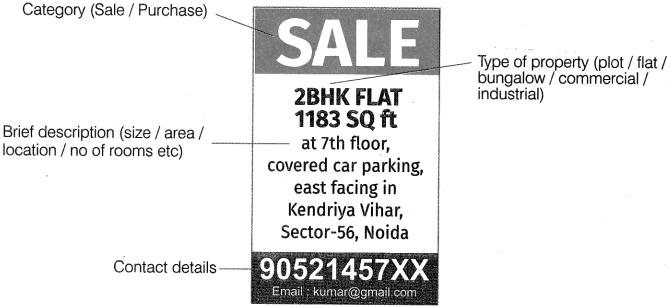
Question 1.
You plan to sell your flat. Draft a suitable advertisement to be inserted in the classified columns of a local daily giving all necessary details of the flat.
Answer:
Flat For Sale
At Mukherjee Nagar, DDA Flat, SFS-II, Ground floor, Two bedrooms, D/D with full interiors for sale. Car parking available. East/ park facing. Reasonable price.
Contact AB Singh 011-2723XXXX
Question 2.
You are General Manager of PNT Company, NOIDA, which requires to purchase posh bungalows as guest houses. Draft an advertisement under classified columns to be published in ‘The Tribune’.
Answer:
Bungalows Wanted
Wanted high end bungalows in various posh locations in South Delhi to be run as guest houses. Uninterrupted water and electricity supply is a must. Near market and other facilities will be preferred. Owners please contact with lowest rates, terms and conditions etc to General Manager, PNT Company, Noida Phone no 0120- 42242XX.
e-mail : divyAnswer:h174@gmail.com
Question 3.
You are Surinder Singh from Ludhiana, Punjab. You want to buy a plot for constructing a warehouse. Draft an advertisement for the same in ‘The Times of India’ under the classified column.
Answer:
Plot Required In Ludhiana
Roadside plot for constructing warehouse on the outskirts of Ludhiana on GT Road. Minimum area of 500 sq mt. Contact Surinder Singh, R- 35, Naya Mohalla, Ludhiana, Punjab.
Call 098765XXXXX with the best terms.
Advertisement Writing Examples for Students
1. Maria Agnes, House no 196, Mapusa, Goa, wishes to sell her house as she is migrating to the USA. Draft an advertisement for her for publication in the ‘For Sale/Property’ section of the newspaper.
2. You wish to open a showroom for ‘Adidas’ and are looking for a suitable place to purchase. Draft an advertisement for it to be published in ‘The Tribune’, New Delhi, under classified columns, giving all relevant details.
3. You have a spacious bungalow in Saket. You want to sell the first floor to a genuine buyer. Draft an advertisement giving necessary details.
4. You are Dr. Geetanjali, MD. You are looking for an independent house in Gurgaon at a reasonable cost for a residence-cum-clinic. Draft a suitable advertisement to be published in ‘Hindustan Times’, New Delhi.
5. You want to dispose of your independent house situated in a prime locality of Ghaziabad. Draft an advertisement to be published in ‘The Times of India’ under the classified advertisements column. Sign as Manohar/Meenu.
TYPE 2B
Sale/Purchase (Vehicle)
Details Required
- Start with ‘Sale / Purchase’ or ‘Available / Wanted’
- Model, year of manufacturing
- Features/ accessories fitted
- Ownership details
- Insurance details
- Type/ make of vehicle
- Colour
- Mileage and condition, new or second hand
- Kilometres run/ done/price expected
- Contact address/ e-mail/ phone number
NOTE: Some details are optional
Format Of Sale/Purchase (Vehicle)
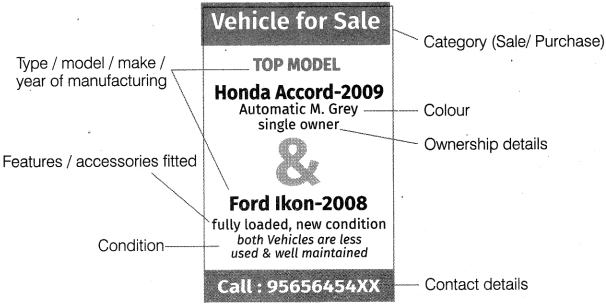
Question 1.
You want to sell your flat in Ashok Vihar. Write out an advertisement giving necessary details in about 50 words.
Answer:
FOR SALE
For Sale Ashok Vihar, DDA flat, first floor, two bedrooms. Drawing/ Dining with full interiors, Car parking available. North/ park facing, located near the main market. Reasonable price. Contact: M.L. Goyal, 27263412
Question 2.
You plan to sell your motorcycle. Draft a suitable advertisement to be published in the classified column of the ‘Hindustan Times’, Delhi. Invent all necessary details.
Answer:
Motorcycle For Sale
Top Model Hero Karisma-2010 Available a yellow Hero Karisma with disk brakes, double speed engine, 180cc, alloy wheels, digital meter, tail brake lights, 50 km/h, sparingly used, fully insured, good condition. Sale price negotiable.
Contact Shravan Kumar, 78124679XX
Question 3.
You wish to buy a second-hand owner-driven car in good condition. Draft an advertisement for the same in ‘The Indian Express’ under the classified column, giving your preferences.
Answer:
Required Small Car
Required purchase of the second-hand owner-driven small car in good condition. Preferred makes Maruti/ Hyundai/ Ford. Must be Delhi registered. Contact with the best price, Alok Mohapatra, Flat 304, SKS Society, Sector 29, Gurgaon. Phone 098123XXXXX
Advertisement Questions for Class 11
1. You want to dispose of your car as you are going abroad. You are Ritesh of House no 17, Kailash Colony, New Delhi. Draft an advertisement to be published in the daily, ‘The Hindu’, under classified columns.
2. You wish to purchase a Harley-Davidson motorcycle. Draft an advertisement for it to be published in ‘The Statesman’, Kolkata, under classified columns giving your preferences.
3. You plan to sell your mini-bus, as you are going abroad. Invent all necessary details dong with the facilities available on the bus. Draft this advertisement to be published in the locd ddly under classified columns.
4. You are Harpd Singh, owner of Harpd Transport Agency. You wish to sell one of your trucks used in
transportation. Draft a suitable advertisement to be published in ‘Punjab Kesari’, Delhi, under classified columns.
5. You would like to purchase a Ford Endeavour car, 2009 model. Giving dl its required details, draft an advertisement for a national daily in the classified columns.
Type 2C
Sale/Purchase (Household/Office Goods)
DETAILS REQUIRED
- Start with Sale! Purchase or Available / Wanted
- Product brand, model, year of manufacture
- Duration used? period of usage/ when purchased
- Price offered? expected (optional)
- Contact address f e-mail I phone number
- Name/ Type of household/ office item
- Product features
- Condition
- Specify material (in case of furniture)
Format Of Sale/Purchase (Household / Office Goods)
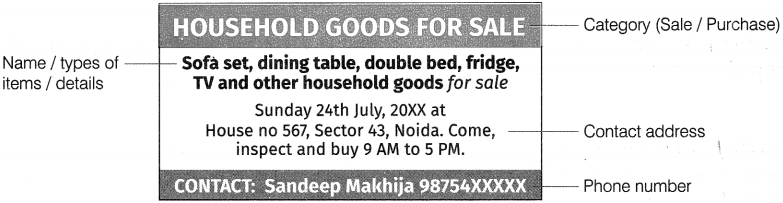
Question 1.
You are Sunny! Sammy. You wish to dispose of an old washing machine. Draft a suitable advertisement with your contact details.
Answer:
For Sale – Lg Washing Machine
Quick Sale LG Washing Machine, Model TO 1129, 2008 purchased, white, excellent condition, fully automatic, under warranty. Attractive price. Contact Sunny, Sitapur Road, Lucknow, 81181191 XX.
Question 2.
You are moving to a new city with your family. Draft an advertisement for disposing of items of furniture and electrical equipment to be published in a local newspaper.
Answer:
For Sale – Household Items
Available 6 seater sofa, teakwood, in excellent condition with Dunlop seats, glass centre table, two LG AC’s, LG Microwave, Samsung fridge, dining table with four chairs, two double beds. Reasonable sale offer, owner moving to a new city. Contact Brijesh Saini 99944422XX
Question 3.
You are the Distribution Manager of Alka Foods in Ambala, where you have recently taken an office on rent. You wish to buy new/used office furniture for the office. Draft an advertisement giving details of the same in ‘Punjab Kesri’ under the classified column.
Answer:
Require Office Furniture
Require office furniture (new/used in good condition) including sofa set, office tables, and chairs, water coolers, stools for new distributor office at Sadar Bazar, Ambala. Contact with details and best prices, Distribution Manager, Alka Foods on phone 098456XXXXX.
Example Questions
1. You are Mayank. You are leaving for Germany to pursue an engineering course and so wish to sell your high definition motion gaming console with built-in 85 exciting real action wireless games. Draft a suitable advertisement for publication in ‘Hindustan Times’ advertising the sale of the gaming system, giving features and relevant details.
2. You are Anmol Juneja. You want to purchase a second-hand laptop. Draft a classified advertisement for a local daily giving necessary details.
3. You wish to sell your Kaff chimney along with Kaff gas stove. Draft a suitable advertisement for a local daily, giving all the necessary details. You are Samarth / Samarthi of 21 A, First floor, Shalimar Bagh.
4. You are Rajat/ Radha and wish to buy a new set of furniture and dispose of the old one. Draft a suitable advertisement in not more than 50 words. Give all the necessary details.
5. You have been transferred to another city. You want to sell certain household goods. Draft a suitable advertisement to be inserted in a newspaper in 50 words.
TYPE 3
To Let
Details Required
- Give heading ‘To Let’ or ‘Available’ or other suitable phrases
- Details of accommodation — number of bedrooms, size of rooms, bathrooms, etc
- Brief description of the accommodation
- Fixtures and fittings (if any)
- Location and surroundings
- Facilities — water/electricity supply, park facing, proximity to market, school, etc. Type of construction
- Preference of tenants—small family, company lease, etc. Rent expected, the agreement required, other terms
- Contact address/ e-mail/ phone number
Format Of To Let
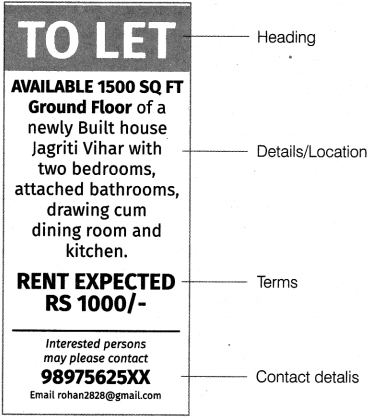
Question 1.
You want to let out a flat. Prepare an advertisement to this effect for publication in a newspaper, giving the location of the building, nature of accommodation, rent expected etc.
Answer:
To Let
Available on rent Sushant Lok, Ansals MIG flats, II floor, two B/Rs, lobby, balcony, fully furnished, well-ventilated. Walking distance from the main market & taxi stand. Rent expected 5000 (fixed). Company lease preferred. Contact Subodh 2B/31, Sushant Lok, Ph. 27521012
Question 2.
A US-based NRI wants to let out his three-bedroom independent floor in Green Park, New Delhi. Write an advertisement for publication in the classified columns of a local daily. Provide suitable details.
Answer:
To Let
Available on lease for two years 3BFIK independent floor in Green Park, New Delhi. Park facing with all modern amenities. Well-ventilated and modern construction. 24-hour water supply, power back-up, lift facility, strong security, fully furnished, parking space. Owner US-based NRI.
Contact Milind Oberoi, Phone 998899XXXX
Question 3.
You are Advocate TL Gupta. You are looking for an independent shop in Gurgaon on a reasonable rent for your office. Draft a suitable advertisement to be published in a local newspaper.
Answer:
Required Shop On Rent
Independent shop required in Gurgaon main road for lawyer’s office, reasonable rent. Contact TL Gupta on phone 098765XXXXX or e-mail details on tig456@gmail.com.
Advertisement Questions for Students
1. You are the Regional Manager of Lakshmi Bank, Mumbai. As your bank is introducing 24 hours banking facility for its customers, some ATM machines are being installed in certain localities. Write an advertisement to be published in the classified columns of a newspaper for suitable premises on rent to be used as ATM centres for the company.
2. You own a commercial flat suitable for an office/ bank. You wish to rent it out. Draft an advertisement to be published in ‘The Times of India’, New Delhi under the classified columns.
3. You are running a real estate agency in Faridabad. You have to give an advertisement for tenements and apartments available for rent. Draft an advertisement for the ‘To Let’ column.
4. You are Rohit Roy of 24, Chitranjan Park, Kolkata. You want to let out your own house only to some Central Government employees. Draft an advertisement to this effect for publication in the Statesman, Kolkata, giving the details of the building and rent expected.
5. You want to hire accommodation for your newly started business in readymade garments in Chennai. Write an advertisement for the same to be published in the classified columns of ‘The Hindu’.
TYPE 4
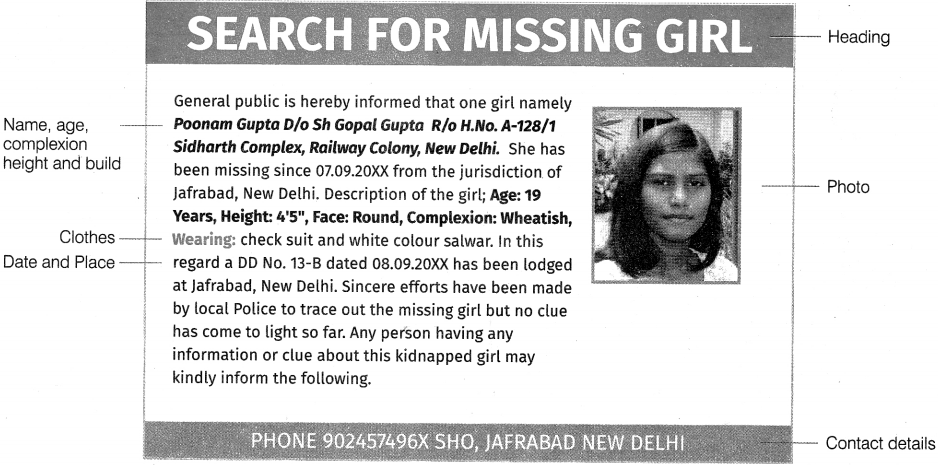
Missing (Persons and Pets)
Details Required
- Give heading ‘Missing’
- Contact address / e-mail / phone number
Person
- Name, age, complexion, height and build
- Brief physical description
- Health and mental condition
- Clothes and other identifying features
- Photo (optional)
- Date and place (since when / from where missing)
- Indicate reward, if any
Pet
- Brief physical description
- Name, breed, age, colour of fur / skin etc
- Identifying features
- Answer to what name etc
Format Of Missing (Persons And Pets)
Advertisement Questions and Answers Class 11 CBSE
Question 1.
You are Prashant /Purnima of 202, Laxmi Nagar, New Delhi. You lost your briefcase while travelling by bus from Laxmi Nagar to Connaught Place, New Delhi. The briefcase contains some valuable documents, including your Board’s certificate for Ml India Secondary School Examination. Draft a notification in not more than 50 words to be published in The Indian Express under their column “Lost & Found”. Include all necessary details about the lost briefcase to establish your claim.
Answer:
I lost my brown VIP ‘classic’ brand briefcase with ‘Prashant’ written near the handle while travelling by DTC route no. 89 from Laxmi Nagar to Connaught Place. It contains some valuable documents. The finder will be suitably rewarded. Contact: Prashant, 202 Laxmi Nagar, New Delhi or Phone 27190048
Question 2.
Your cat is missing since the last two days. Write an advertisement to be published in the missing column of classified advertisements in ‘The Tribune’.
Answer:
Missing
a beautiful tabby cat named Tessa, white and brown fur, 1-year-old, healthy, since 4th March 2OXX from Khan Market. If found please contact Saravjeet Kaur, House no 83, Lajpat Nagar, Delhi, Phone number 011 -267628XX.
Question 3.
Your old grandfather left the house a week back to go to the market and has not returned. Draft an advertisement for the newspaper.
Answer:
Missing
My grandfather, who Answer to the name of Sandeep Taneja, left our home at 5 PM to go to the market on 27th July, 20XX, and has not returned. He wears a black shirt and white trousers and he is 174 cm tall. He is mentally unstable. Anybody who gives information which leads to finding him will be suitably rewarded. Contact Paras Taneja, A – 22, Sector 63, Faridabad. Phone 92136XXXXX
Advertisement Examples for Class 11
1. You had visited the International Trade Fair that was very crowded and your 6-year-old son got lost in the crowd. He has been missing since then. Write an advertisement for the newspaper.
2. Your horse is missing for a week. Write an advertisement to be published in the missing column of classified advertisements in ‘The Indian Express’.
3. Your niece, a child of 10, has got lost while she went on a school picnic. Giving full details of the missing child, draft an advertisement for a newspaper.
4. You are Poonam / Prateek Gupta of 70, Chandni Chowk, New Delhi. Your pet dog Buzo is missing. Write an advertisement for the missing pet column of a newspaper.
5. A neighbour’s child has gone missing. The neighbour seeks your help in drafting a suitable classified advertisement for the missing child. Draft an advertisement in which you should mention a reward for the recovery of the child.
TYPE 5
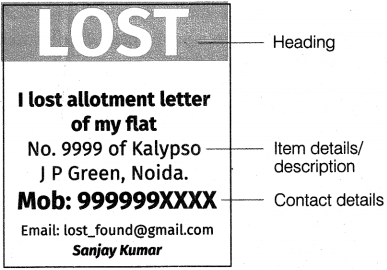
Lost and Found
- Give heading ‘Lost’ or ‘Found’
- Specify the items
- Brief description
- When and where lost/found
- Reward, if any
- Contact address/e-mail/phone number
Format Of Lost And Found
Question 1.
Mr Aggarwal lost his passport while travelling in the Metro on the yellow line from Model Town ’ to Rajiv Chowk Metro Station. Draft an advertisement to be placed in the Lost and Found section of the classified columns Hindustan Times’.
Answer:
Lost
An Indian passport bearing No A330007 in the name of Satish Aggarwal along with an Air France ticket to Paris got Lost on 17th February on the Metro route from Model Town to Rajiv Chowk at approximately 10 AM. Finder contacts Satish Aggarwal, Flouse no 243, Model Town, New Delhi. Phone- 97112402XX. The suitable reward promised.
Question 2.
You have found a briefcase in a bus to Ajmer. Write an advertisement for the ‘Lost and Found’ column in the newspaper.
Answer:
Found
A black American Tourister briefcase was found while travelling by a bus from Delhi to Ajmer on 19th March, 20XX, contains documents and driving license. Will be returned to the owner after the particulars and details of the content are given. Please contact Swaraj Singh, 99222348XX.
Question 3.
You have lost your suitcase while travelling in the sleeper compartment of a train. Draft a suitable advertisement for the classified columns of the local daily giving all relevant details and promising a reward.
Answer:
Lost
A brown suitcase measuring 100 cm X 60 cm containing clothes and other personal belongings while travelling in sleeper S – 7 of Toofan Express from Agra Cantt to Durgapur on 12th-13th May. Finder contact Binod Mukherjee on phone 098658XXXXX or e-mail: bmukherjee265@gmail.com. Reward promised.
Advertisement Examples for Class 11
1. Shivangi Mittal has lost her original school certificates while travelling on the Delhi Metro from Vishvidyalaya to Green Park. Write an advertisement for the ‘Lost and Found’ column of a national daily.
2. You have lost your newly purchased I-Phone 6s in a cinema hall. Draft a suitable advertisement for the ‘Lost and Found’ column of a national daily.
3. You have found a book in the name of Sakshi Thakur lying on a table in a coffee shop. Draft a suitable advertisement for the ‘Lost and Found’ column of a national daily.
4. You have lost your wristwatch in a public park. Draft a suitable advertisement for the classified columns of the local daily giving all relevant details.
5. Write a classified advertisement for the ‘Lost and Found’ column of a local newspaper stating the loss of your purse containing some cash and other important documents.
Type 6
Tours And Travel
Details Required
- Give heading ‘Package Available’ or another suitable phrase
- State the name of the travel agency
- Specify destinations, duration etc
- Details of package – food! boarding! lodging! sight-seeing etc
- Indicate the cost and special discount, if any
- Contact address? e-mail? phone number
Format Of Tours And Travel

Question 1.
You are the proprietor of Shatabdi Travels and have organised a 3 nights? 4 days package for Singapore. Draft the advertisement for a national daily to draw people to it.
Answer:
Tours And Travel
Attractive package available for Singapore, 3 nights! 4 days, breakfast and dinner, stay at 4-star hotels, inclusive of sight-seeing and transfers, 49,999 per person. Special Diwali discount for bookings before 10th November. Contact Shatabdi Travels, N-24, Outer Circle, Connaught Place, New Delhi. Phone 98122567XX, O11-225672XX
Question 2.
As a travel agent, draft a suitable advertisement offering an attractive package.
Answer:
Tours And Travel
Star Line Cruises offers special cruises to Dubai, Singapore, Mauritius, Seychelles, and the Maldives. Most exciting and thrilling itineraries for individuals/couples and groups. Deluxe hotels and choice of Continental, Chinese, Indian and local cuisine. Courteous and multi-lingual tour guides for sight-seeing. Daily departures at very attractive rates. Special discounts for families. Children below 8 years free. Contact for booking Star Line Cruises, 26, 1st Floor, Khan Market, New Delhi. Phone 011-411411XX
Question 3.
Shanti Travels at 208, Western Road, Meerut offers a pilgrimage tour ‘Char Dham Yatra’by bus from Delhi for 10 days. Draft a suitable advertisement on behalf of Shanti Travels for the classified columns of a newspaper.
Answer:
Char Dham Yatra
Shanti Travels offers a 10-days pilgrimage tour to Badrinath, Kedarnath, Gangotri, and Yamunotri every week starting Delhi 17 May. Cost per person is ? 18500 inclusive of Deluxe bus travel, overnight stay, all meals, and taxes. Contact us at 208, Western Road, Meerut or on Phone 0992557XXXXX during working hours.
Advertisement examples for Class 11
1. You are the General Manager of Dream Travels. You want to insert your advertisement in the classified columns because the holiday season is approaching and lots of people will like to go on guided tours. Draft a suitable advertisement.
2. You are the proprietor of Happy Travels and have organised a 20-day tour of Europe for 2,10,000 inclusive of two meals a day. Draft an advertisement for a national daily.
3. First Flight Travels, Shop No 62, Upper Basement, Pacific Mall, Subhash Nagar, New Delhi offers its patrons the cheapest air tickets for any destination by an airline on booking two months in advance. Draft a suitable advertisement.
4. Draft a classified advertisement on behalf of ‘Trips and More’ offering attractive holiday packages especially suited for honeymoon couples.
5. Easy Travels offers customised package tours where customers can decide the mode of travel and duration of stay. Draft a suitable advertisement on behalf of Easy Travels for the classified columns of a newspaper.
Type 7
Matrimonial Alliance
Details Required
- Give heading ‘Wanted’, ‘Required’, ‘Available’ etc
- Give personal details such as
Looks and appearance
Age, height, complexion
Educational/ professional qualifications
Family background, community etc
State your preferences, if any
Contact address/ phone number/ PO box number/ e-mail
Format Of Matrimonial Alliance

Question 1.
You are looking for a suitable match for your smart, good-looking daughter. Draft an advertisement for publication in the newspaper.
Answer:
Groom Wanted
Suitable match for a cultured, smart, good-looking, MBA girl, 23/5’5″ daughter of Army Officer. Boy must be well qualified from a good family. Caste no bar. Early marriage. Box No 7252 Hindustan Times, New Delhi.
Question 2.
Write a suitable matrimonial advertisement for your divorcee but an educated friend.
Answer:
Bride Wanted
Suitable match for a 31 yrs, Iyer boy. Issueless divorcee after three months of marriage. 170 cm, wheatish complexion, lean, modest, M Tech, IT literate, well settled, only child of a well-to-do harmonious family. Requires a smart, educated girl from a good family. Simple early marriage. Caste no bar. Contact Box No 8484, The Indian Express, New Delhi.
Question 3.
You are Raj Kumar, a divorcee aged 55 years residing in Dubai as an NRI and want to return to India. Draft a suitable advertisement for a match for you in ‘The Times of India’ under the classified column.
Answer:
Bride Wanted
NRI Divorcee, 55. Hindu, good looking, slim, wheatish, well-settled businessman, planning to settle in India, internationally travelled, Caste no Bar. Photo pis. rajkumar51@hotmail.com
Advertisement Questions for Class 11
1. A 26-year-old highly qualified software engineer seeks a suitable alliance with an educated bride. Write a suitable matrimonial advertisement for a match for him for the classified columns of a newspaper.
2. Draft a matrimonial advertisement on behalf of your neighbour who is seeking a suitable match for his physically handicapped daughter.
3. A highly qualified IT professional settled in New York seeks a matrimonial alliance with an exceptionally beautiful, educated, cultured and tall girl of good status Punjabi family. Write a suitable advertisement for the matrimonial column of a national daily.
4. You are the only child of your father. Soon you are going to get married, leaving your father alone, as you lost your mother when you were just 9 years old. Draft a matrimonial advertisement seeking a suitable match for your father.
5. Write a matrimonial advertisement for publication in a newspaper for a suitable match for your sister who is a widow with a 3-year old son.
TYPE 8
Obituary/Remembrance
Details Required
- Photograph and name of deceased
- Date and cause of death
- Message from family/company
- Background/accomplishments/a tribute to his/her work
- Names of persons giving obituary with their relationship to the deceased
- Details of any special ceremony being held.
Format Of Obituary/ Remembrance

Question 1.
Draft a suitable advertisement announcing the death of your uncle to be published in a newspaper in the ‘Obituary ‘column.
Answer:
Obituary
With profound grief and sorrow, we regret to inform the untimely demise of our beloved uncle Mr. Harinder Prakash on 7th June, 20XX. The Uthala/ Chautha ceremony for the departed soul will be held on 11th June, 20XX at Arya Samaj Mandir, Usha Nagar, Delhi from 3 pm to 5 pm.
Grief-stricken: Family and friends of deceased
Question 2.
Write out a classified advertisement remembering your son, Himanshu Kumar on his 27th Birthday.
Answer:
Remembrance
In loving memory of Himanshu Kumar S/o Shrishanth Kumar. Himanshu left for his heavenly abode on 2nd September, 20XX at Bengaluru. He was a lively soul and played the lead singer in his music band. “We all miss you in every moment of our life and cherish your memories.”
Remembered by
Mrs and Mr Shrishanth Kumar
Nakul Kumar
Payal Kumar
Question 3.
A brief illness and old age resulted in your grandmother’s death. Draft an advertisement expressing your grief and informing people of the last prayers.
Answer:
Chautha
Our grandmother, Ms Sarla Mittal, aged 90, passed away on 21st May after a brief illness. Family deeply grieved at death of our matriarch. Chautha will be held on 24th May in Guldasta Park, Samerpur at 12 noon. Kalwant Mittal and family. Phone 096145XXXXX.
Advertisement Examples for Class 11
1. Siddarth Kalra lost his life in a car accident two years ago. Draft a classified advertisement in his loving memory on behalf of his family members.
2. After fighting against cervical cancer for the last two years, your neighbour’s wife passed away yesterday. Draft a classified advertisement to be published under the ‘Obituary’ column of the newspaper.
3. Your five-year-old nephew was abducted while playing in the society compound. His abduction resulted in his untimely death. Write out an advertisement expressing your profound grief and sorrow.
4. Draft a classified advertisement remembering your late grandfather on his 90th birthday. You are Shanul/ Shanakshi.
5. Someone in your neighbourhood has passed away. The family needs a classified advertisement to announce the death and to inform friends and relatives about the last rites/prayers. Draft the advertisement on behalf of the chief mourner.
TYPE 9
Appeal
Details Required
- Give heading ‘Appeal’ or ‘Help Required’ (optional)
- Reason for appeal
- Specify the help required
- Contact address and phone number
- Specify the nature of the appeal
- Give a brief description of the problem/ issue
- Donations to be sent where I to whom if required
- Inserted by (name / designation)
Format Of Appeal

Question 1.
The Delhi Police have recovered the body of a young boy from an old, dilapidated office building near Nehru Place, New Delhi. They have no proof of the victim’s identity. The police want to issue an advertisement in the local newspaper asking for identification. Draft the advertisement.
Answer:
Appeal For Identification
The general public is hereby informed that an unidentified dead body of a young boy, Age 14 to 16 years, height 5’3″, round face, wheatish complexion, thin built, wearing a navy blue t-shirt and black colour pants has been found from an old, dilapidated office building near Nehru Place, New Delhi. The victim bore injury marks on the forehead and arms. Any person having any due about the deceased may kindly inform SHO, Nehru Place Police Station Te! 011-210121XX.
Question 2.
Write an appeal to be published in a newspaper, inviting suitable donors to offer a kidney to save the life of a young man whose kidneys are damaged beyond repair.
Answer:
Appeal
Help required for a handsome, promising young man, blood group B, lying on a death bed in AIIMS, New Delhi. Both his kidneys are damaged beyond repair. You can save his life and earn the gratitude of his family by donating one of your kidneys. Donors, please contact the Director of the Institute or on Phone 98110-373XX.
Question 3.
The father of a 3-year-old child suffering from chronic liver disease does not have the money for treatment. Draft an appeal to be published in the newspaper on his behalf.
Answer:
Appeal For Donations
My 3-year old daughter Aastha is admitted in Sarvodaya Hospital with chronic liver disease. I am unable to meet her treatment expenses as I am a daily wage worker. The public is requested to help by donating funds for her treatment. Please contact Pravin Salwan on Phone 094567XXXXX.
1. SKY is the main activity centre of a charitable trust ‘Foundation for Spastic and Mentally Handicapped Persons’. It helps and guides parents/ guardians of children with special needs. It tries to improve the quality of life of disabled children wherever possible. Draft an appeal to be published in a newspaper on their behalf asking for donations to their cause.
2. Recent floods in Bihar left millions affected badly and many marooned for weeks. Draft an appeal to be published in a newspaper on behalf of the CM’s Relief Fund asking for donations. All contributions may be sent to the fund at Patna.
3. Thalassemia is a disorder caused by the weakening and destruction of red blood cells. The body requires monthly trAnswer:fusion of blood in people having this disorder. Draft an advertisement appealing to the general public to come forward and donate blood to help such people.
4. A poor accident victim needs financial help for surgery. As the President of a charity organisation that arranges financial help for such people, draft a classified advertisement to raise funds for them.
5. Deepika Nayyar, a 10-year-old girl, is suffering from blood cancer. Does she urgently need 10 lakhs for a bone marrow trAnswer:plant. Prepare an appeal on behalf of ‘Child Relief and You’, a charitable society.
TYPE 10
Educational
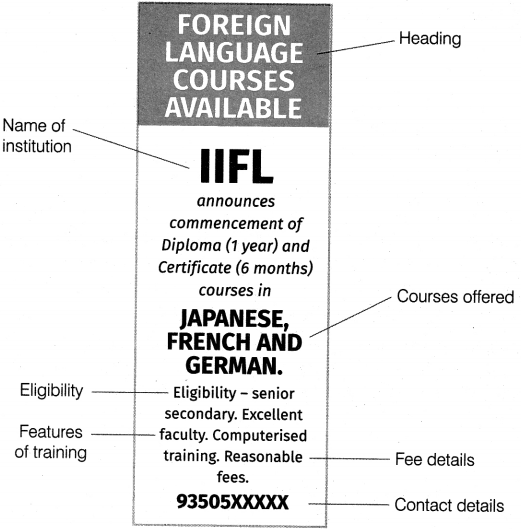
Details Required
- Give heading
- Name of the institution
- Courses offered, duration
- Eligibility criteria
- Facilities Fee structure (optional)
- Job prospects after completion/ placement facilities/ features of the training
- Incentive and discount offered
- Last date for registration
- Contact address/ e-mail/ website/ phone number
Format Of Educational
Question 1.
Draft a classified advertisement announcing crash courses for the preparation of IELTS and TOEFL.
Answer:
Educational
Era Institute offers crash courses for the preparation of IELTS and TOEFL. High scores guaranteed. Highly trained and experienced faculty. Small batches of 10 students. Scholarships are available. Completely air-conditioned and wi-fi enabled campus. Fees – INR 7999. Last date -16th June 20XX. Contact: Era Institute, Phone 011-727472XX
Question 2.
An IIT graduate friend of yours wants to launch an IIT-JEE Competition Tutorial Centre. Draft a classified advertisement for him.
Answer:
IIT – Jee Coaching
Sargodha Competition Tutorial Centre, Kalu Sarai, offers 1-year and 2-year coaching courses for IIT-JEE. Headed by IIT graduate Sunil Manchanda with 10 years’ experience in coaching. Success guaranteed. Fees are payable in installments. For details contact Reception Phone 011 2651XXXX or after office hours 93540XXXXX.
Question 3.
Draft a classified advertisement for your institution which is accredited for running ‘O’ Level Courses. Give details of minimum qualification, fees, etc.
Answer:
Doeacc ‘O’ Level Computer Course Available
Sarvodaya Computer Institute runs 1-year Foundation Level Course in Computer Applications equivalent to DOEACC ‘O’ Level. Our Accreditation No is 014XX. Minimum eligibility as per DOEACC norms. Fees reasonable & payable in installments. For other details contact Reception Phone 011- 2829XXXX or Malay Saran on Phone 92106XXXXX.
1. You have recently started a coaching centre for yoga at Rajaji Nagar, Bengaluru. Draft an advertisement to be published under the classified columns of ‘The Deccan Herald’.
2. You are the Director of Career Time, Punjabi Bagh, New Delhi. Write out an advertisement for admission to prepare for various competitive exams like CAT, MAT, GMAT etc.
3. You have been asked to draft a classified advertisement offering cookery classes for various age groups. Also provide details regarding cuisine, total cost, duration etc.
4. As Vivan/ Vishakha, you feel perturbed looking at the plight of children with special needs. You decide to start an educational institute by the name of ‘Fly High’ for such children. Draft a suitable classified advertisement for publication in the newspaper.
5. Animation courses are popular as a career option. Draft a suitable advertisement offering animation courses to be published in the ‘Educational’ column of a popular newspaper.
TYPE 11
Change of Information
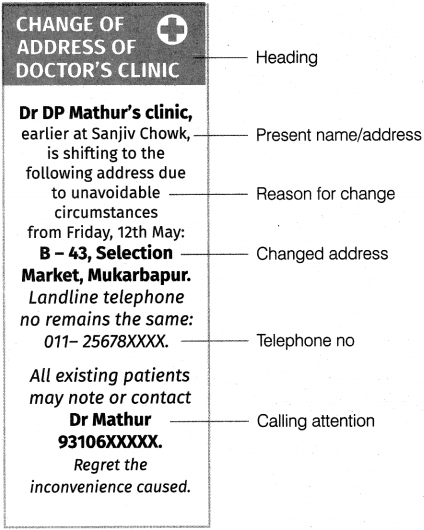
Details Required
- Heading
- Father’s name/ Husband’s name (if applicable)
- Reason for change
- Present name/ address/ other information
- Changed Name/ address/ other information
- Calling the attention of the public, relatives, and friends
Format Of Change Of Information
Question 1.
You as a Vasu Sharma, need to change your name and address due to your marriage. Draft an advertisement to declare the change.
Answer:
Change Of Name
Vasu Sharma, daughter of Ramkishan Sharma resident of 31, Park Avenue, 63 Street, Kolkata, hereby declare that I have changed my name to Vasu Arora after my marriage to Vineet Arora, son of Pankaj Arora of House no 211, Karol Bagh, New Delhi. All concerned are requested to note and to address me by my new name.
Question 2.
You have changed your name from ‘Kulwant Singh Talwandi’ to ‘Kulwant Talwandi’ through an affidavit. Inform the general public about the changed name by drafting a classified advertisement to be inserted in a local newspaper.
Answer:
Change Of Name
I, Kulwant Singh Talwandi s/o Jagir Singh Talwandi, have changed my name to Kulwant Talwandi by an affidavit sworn before the Notary Public, Janakpuri, New Delhi on 24th May, 20XX. Henceforth, I shall be known as Kulwant Talwandi for all purposes.
Question 3.
Draft a classified advertisement for your company, Shraddha Distributors, which has shifted their administrative office. You are Jagdish Sareen, MD of the company.
Answer:
Change Of Office Address
Shraddha Distributors, a distributor for Kolkata biscuits Ltd, has shifted its administrative office from the First floor, 43, Park Road to Ground Floor, 75A, Park Road wef 23rd June, 20XX. Our Telephone no remains the same 033 – 2624XXXX. All dealers are requested to note.
Jagdish Sareen, Managing Director, Shraddha Distributors.
1. You wish to get your family name added to your particulars on your passport after getting married for which you need to get a public notice published in a newspaper. Draft a suitable advertisement declaring the change of your name.
2. Due to renovation work in your present house, you need to change your residence. Draft a suitable advertisement declaring the change in address.
3. You are the Company Secretary of Liladhar & Sons Pvt Ltd. Your company telephone numbers have changed because of the expAnswer:ion of the local telephone exchange. Write a classified advertisement to be put in the local newspaper informing all about the new numbers.
4. You are the President of the builder Maryada Housing Group. The company has changed its bank account to Kotak Mahindra Bank from its earlier bank, State Bank of India. Write a classified advertisement to be put in the local newspaper informing all persons who have booked flats in your various buildings, informing them about the changed bank and the new account number, branch name etc, and asking them to deposit all their dues in the new bank account.
5. You are Sarvar Hasan, formerly the Marketing Head of Sahil Foods Ltd. You have joined a new company. Draft a classified advertisement about the change to be inserted in a local newspaper, giving details of who your former customers should contact to deal with your former company.
Commercial Or Display Advertisements
These advertisements are designed for commercial purposes. They are used by leading manufacturers, establishments, organisations etc for publicity and promotion of their products, services or events.
Essential Details
- Name/ logo of the company/ institute/ organisers etc.
- Details regarding the product/ event/ educational courses etc.
- Special offers or discount, if any.
- Address and contact details of the company/ institute/ organisers etc.
The main characteristics of a Commercial I Display advertisement are
- Designed for commercial purposes.
- Requires more space and thus more expensive in terms of the advertising costs.
- Has to be visually attractive with catchy slogAnswer:, punch lines, witty expressions, pictures etc..
- Font size, type and proportionate spacing varies with each advertisement.
- Colourful and lucid languages used.
Making Scheme of Commercial/Display Advertisement
- In the paper, a question on a classified advertisement will test the following value points.
- Content Subject matter including a contact address, phone number
- Expression Grammatical accuracy, spelling, suitable style.
Format Of Commercial / Display Advertisement
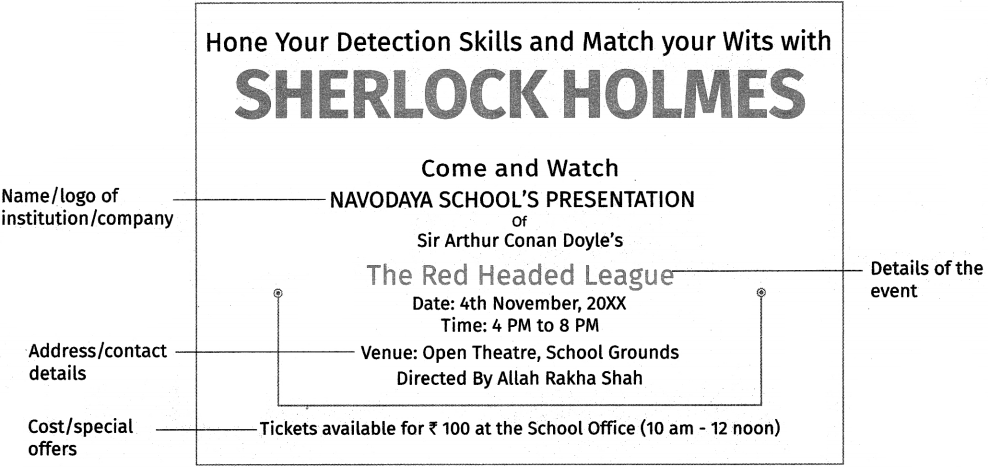
Your school is staging Sir Arthur Conan Doyle’s ‘The Red-Headed League’ starring Sherlock Holmes. Draft a commercial advertisement for the newspaper giving all the details.
Commercial Advertisement Writing Questions and Answers for Class 11 CBSE Pdf
Question 1.
You are working for an advertising agency. Draft an attractive advertisement for a company which is launching a new toothpaste.
Answer:

Question 2.
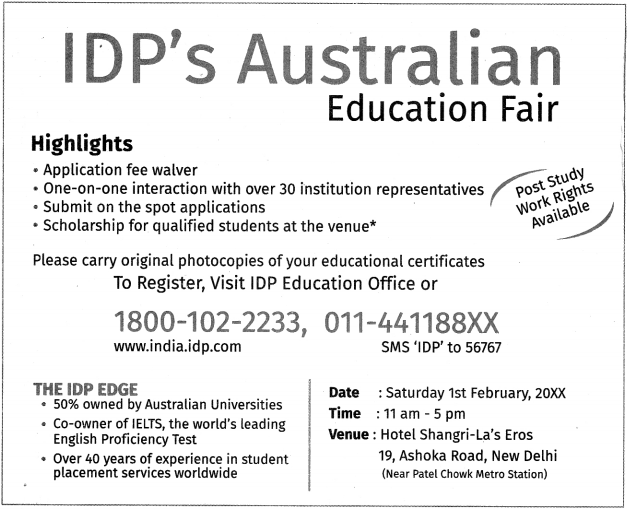
The IDP’s ‘Australian Education Fair’ is being organised on 1st February at Hotel Shangri-La’s Eros, 19, Ashoka Road, New Delhi. Design a commercial advertisement for the same.
Answer:
Question 3.
A well-known brand of kitchen chimneys wants to sell its stock by giving a special festival discount. Frame a suitable commercial advertisement for inserting in a newspaper.
Answer:

Question 4.
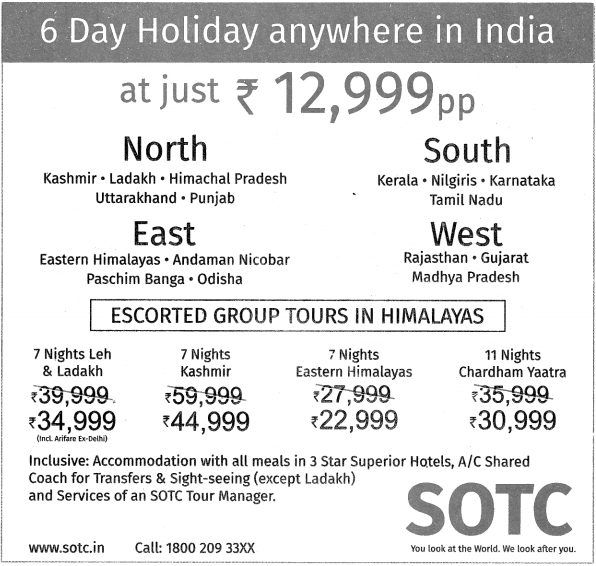
SOTC Tours and Travels needs a display advertisement for newspapers and magazines to attract more tourists to it. On behalf of SOTC, create the advertisement.
Answer:
Question 5.
L’oream has come up with an all-new shampoo. Create a display advertisement describing the salient features of the product, inviting people to try it.
Answer:

Question 6.
The ITA School of Performing Arts, Goregaon (W), Mumbai is inviting students to join. Draft a suitable commercial advertisement.
Answer:

Question 7.
The popular online website ‘maaptol.com’ is offering a complete car maintenance combo at an unbelievably low price. Frame a suitable display advertisement drawing the attention of the readers.
Answer:

Question 8.
A Design Fair is being organised by Nature Bazaar showcasing 50 innovative designers’ contemporary designs using traditional craft skills. Draft a suitable commercial advertisement for a local newspaper.
Answer:

Question 9.
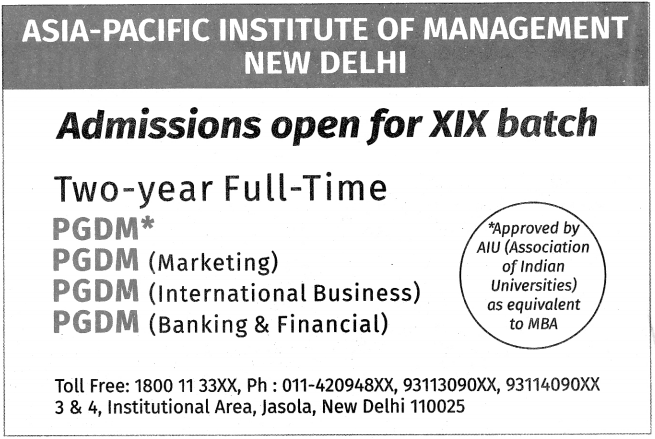
You have been asked to draft an advertisement for Asia-Pacific Institute of Management, a B-School in North India providing two year full-time management course.
Answer:
Question 10.
You are the Director of ITM Education Centre announcing new programs in Business Administration. Write an advertisement in about 50 words for publication in a newspaper.
Answer:

Commercial Advertisement Writing Examples for Class 11 CBSE Pdf
1. You are working for an advertising agency. Draft an attractive advertisement for a company which is launching a new hair oil. Invent the details.
2. Your friend has come up with a new designer wear boutique for both men and women. Help her draft an attractive display advertisement to draw customers.
3. Draft an attractive commercial advertisement for a newly opened beauty salon and spa by the name of ‘Exotica’. Your advertisement must promote its services in an appealing way.
4. For a solid grounding and a wide perspective in the art of theatre, Shri Ram Arts Institute, a theatre training institution, provides training in traditional Indian theatre forms, Asian drama, and Western dramatic protocols. On behalf of the Director of the Institute, frame a commercial advertisement to be published in a local daily.
5. Frame a suitable display advertisement for a ‘Tours and Travels’ company organising domestic as well as international tours. Invent the details.
6. A chemical company by the name of ‘Pure White’ is launching a new detergent. Prepare an attractive advertisement announcing its launch and highlighting the qualities of the product.
7. Jet Airlines have come up with a new airline ‘Super Jet’. Draft an advertisement launching this new airline. Invent the necessary details for promoting it. You can also offer attractive discounts on bookings.
8. Solar cars are now a reality. They come with low maintenance costs and good speed. Draft an attractive display advertisement for the prospective buyers stating their advantages.
9. Mineral Group has launched their new water purifier. It comes with the RO system and provides clean and healthy drinking water with zero impurities. Design a suitable commercial advertisement.
10. The music sensation, Fady Gaga, is coming to India and will perform at Red Fort in Delhi. Draft an attractive commercial advertisement announcing the concert and giving details regarding the event.
Advertisement Writing Assessment Class 11 CBSE Pdf
(Here we have covered Classified or Commercial/Display advertisements.)
1. You are the HR Manager of Elephanta Software Services. You require software engineers familiar with ERP Software Oracle with a minimum of 5 years’ experience. Draft a suitable classified newspaper advertisement for the same.
2. You want to purchase a 400 sq m or larger plot in Gomti Nagar, Lucknow, for building a bungalow. Write a classified advertisement for a local daily giving your requirements.
3. You are interested in selling your Maruti Eeco Van which has run 10000 km and is 3 years old. Draft a suitable classified advertisement for the ‘Vehicle for Sale’ column of a local newspaper giving all details.
4. You have changed your job and are leaving the city. You want to sell all your furniture, refrigerator, car, air conditioner etc before moving. Insert a suitable classified advertisement in a local newspaper for the same.
5. Your company, Sarvan Constructions Ltd, requires large flats on rent in Metro cities to serve as guest houses for your touring staff. The flats should preferably be furnished. As Administrative Manager of your company, draft a suitable classified advertisement to be inserted in newspapers in Metro cities.
6. Your pet dog, a black Pomeranian Answer:wering to the name ‘Pommy’, has been lost outside the compound of your housing society and is not traceable for the last 3 days. Insert a suitable classified advertisement to be inserted in a local newspaper, offering a reward.
7. You have changed your surname due to getting remarried after being widowed. Inform all concerned by drafting a suitable classified advertisement for the ‘Change of Name’ column of a local newspaper. You are Parul Shreshtha (new name).
8. You have lost your wallet containing a large amount of cash and some identification documents while travelling in a bus from Lucknow to Etawah. Write a classified advertisement to be inserted in the ‘Lost & Found’ columns of The ‘Times of India’, Lucknow edition, offering a reward for its recovery.
9. You are the proprietor of Anil Tours, a travel agency specialising in pilgrimages. Design a suitable classified advertisement to be inserted in the ‘Tours & Travel’ columns of a local newspaper. Give some details of the packages offered.
10. Compose a matrimonial advertisement for the classified advertisement section of newspapers for the marriage of your sister. State her age, height, weight, qualifications and any other features you feel should be mentioned. Specify what you are looking for as the ideal husband for her.
11. Write an Obituary notice for the classified columns of a local newspaper for your father who died yesterday. Give details of the last rites ceremonies proposed.
12. Issue an appeal for organ donation to be inserted in the classified columns of a local newspaper on behalf of the NGO ‘Society for Helping the Poor’. Specify that all orgAnswer: donated will be used for helping only the weaker sections of society.
13. Your institution is running coaching classes for candidates attempting the NEET examination. Draft an advertisement for the classified advertisement section of the newspaper giving the various courses offered.
14. You are the Creative Director of an advertising agency. Draft an attractive commercial advertisement on behalf of Safal Vajradanti Toothpaste giving a visual and stating the advantages that this brand has over others.
15. Prepare a commercial advertisement for advertising the feature film ‘Antony ki Arpita’ featuring famous stars. Give a visual and at least 3 attractive features of the film.